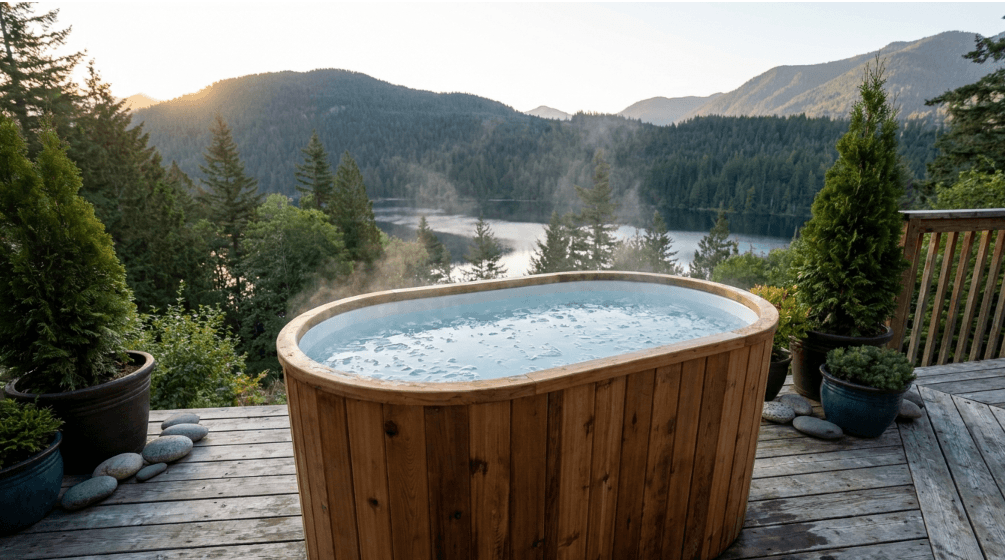
Sizing a cold plunge comes down to three formats: a compact solo tub (45 to 65 gallons, about 3 feet across) for one person in a tight footprint, a mid-size shared tub (80 to 130 gallons) for a household of two, or a spool-style plunge (200 gallons and up) built for two people submerged at once. The right pick depends on available floor space, the surface’s weight rating, and how many people plan to use it in a typical week. Most single renters and apartment dwellers land in the compact category, while homeowners with a dedicated patio or basement corner often step up to the mid-size option.
Compact Solo Tub: Who Is It For?
A compact tub in the 45 to 65 gallon range is built for one person and one purpose: get submerged to the shoulders, hold a still position, and get out. The footprint is close to 30 to 36 inches in diameter, which fits in a bathroom corner, a small mudroom, or a balcony rated for the load. These units almost always pair with a countertop or floor-standing chiller sized around 1/2 horsepower, since the smaller water volume does not need a large compressor to hold temperature. The main limitation is that a compact tub is a single-user format; sharing it back to back between two people means draining and refilling or running the filtration cycle long enough between sessions to keep water quality acceptable.
Mid-Size Shared Tub: How Much More Space Does It Take?
Stepping up to 80 to 130 gallons typically adds 12 to 18 inches to the diameter, landing around 4 to 4.5 feet across, and calls for a chiller closer to 3/4 to 1 horsepower to manage the larger volume. This size works well for a couple or a small family sharing the plunge across the week without constant refilling, and it is still small enough to sit on a reinforced deck or concrete pad without structural upgrades in most cases. The extra water also means more thermal stability, so temperature swings between sessions are smaller than with a compact tub.
Spool-Style Plunge: When Does It Make Sense?
Once two people want to be submerged together, or the household wants a plunge that doubles as a small soaking pool, spool formats starting around 200 gallons and running well past 500 gallons come into play. These need a real foundation, typically a reinforced concrete pad rated for the full water weight, and a 240V electrical circuit sized to the chiller’s horsepower, often 1.5 to 2 HP for a unit this size. This is no longer a small-space category by most definitions, but some spool models are built narrow and deep specifically to fit a side yard or a corner that a traditional plunge pool would not.
What Actually Determines the Right Size?
Three questions settle it in most cases: how many people will use it, what surface will it sit on, and how much floor space is actually free once furniture and walkways are accounted for. A single person in an apartment should not be shopping spool-size tanks, and a family of four sharing one plunge daily will outgrow a compact tub within a season. Checking a retailer’s current sizing before deciding helps narrow the list; a browse through SweatDecks’ lineup shows how footprint, gallon capacity, and chiller horsepower scale together across the range, which makes it easier to match a model to the exact spot at home before ordering.
Does Filtration Scale With Tank Size Too?
Yes. A compact tub usually runs a single cartridge filter cycling for a few hours a day, while a mid-size or spool unit needs a larger sand filter or dual-cartridge setup plus an ozone or UV stage to keep pace with the extra gallons and more frequent use. Skimping on filtration capacity for a bigger tank is one of the more common sizing mistakes, since it leaves water quality lagging behind the volume increase.
How Does Chiller Horsepower Track With Tank Size?
Chiller sizing is not just about matching gallons to horsepower in a straight line; ambient temperature, how often the lid stays open, and how quickly the household wants the water to recover after use all factor in. A compact 45 to 65 gallon tub usually pairs well with a 1/2 horsepower chiller in a moderate climate, though a hot, sunny install spot can justify stepping up to 3/4 horsepower even at that smaller size just to keep recovery time reasonable between sessions. The mid-size 80 to 130 gallon tub typically wants 3/4 to 1 horsepower, and a 200-gallon-plus spool generally needs 1.5 to 2 horsepower to hold temperature without constantly running. Undersizing the chiller relative to the tank is a common mistake: it technically works, but the unit runs nearly nonstop trying to keep up, which shortens its working life and pushes the power bill higher than a properly matched pairing would.
How Does Space Change the Decision Beyond Just Square Footage?
Floor space is the first filter, but access matters just as much. A compact tub that technically fits in a corner is still a poor choice if there is no room to open the lid fully, reach the filter housing, or route a drain hose without crossing a walkway. A mid-size tub on a shared deck needs enough clearance that people are not squeezing past it to reach a door. Spool-format plunges, because they usually sit permanently once installed, deserve the most planning: measuring not just the footprint but the delivery path, since a large tank that will not fit through a gate or down a side yard becomes a logistics problem before it becomes a sizing problem.
Frequently Asked Questions
What size cold plunge fits on an apartment balcony?
A compact solo tub in the 45 to 65 gallon range, roughly 3 feet across, is the usual fit, and confirming the balcony’s weight rating first matters since a full tub with a person inside can weigh close to 900 pounds.
Is a portable inflatable plunge worth it?
For renters or anyone testing the routine before committing to a hard-sided unit, an inflatable tub paired with a portable chiller is a reasonable low-cost entry point, though the liner needs more frequent replacement than a rigid tank.
How much bigger should a two-person plunge be?
Plan on 80 to 130 gallons for two people using the tub on a rotating basis, and closer to 200 gallons or a small spool format if both people want to be submerged together.
Does a bigger tank mean a bigger chiller bill?
Larger volumes take longer to cool initially but hold temperature more steadily once chilled, so the chiller cycles less often per gallon. Running costs scale with size but not in a straight line.
References
- Effects of cold-water immersion on health and wellbeing: A systematic review and meta-analysis, PLoS One, 2025
- Effects of cold water immersion after exercise on fatigue recovery and exercise performance: meta analysis, Frontiers in Physiology, 2023
- Cold-water immersion (cryotherapy) for preventing and treating muscle soreness after exercise, Cochrane Database of Systematic Reviews, 2012
- By Renee Castillo
- Structured data (JSON-LD)Reference schema for this article (already embedded in the HTML paste-source):